



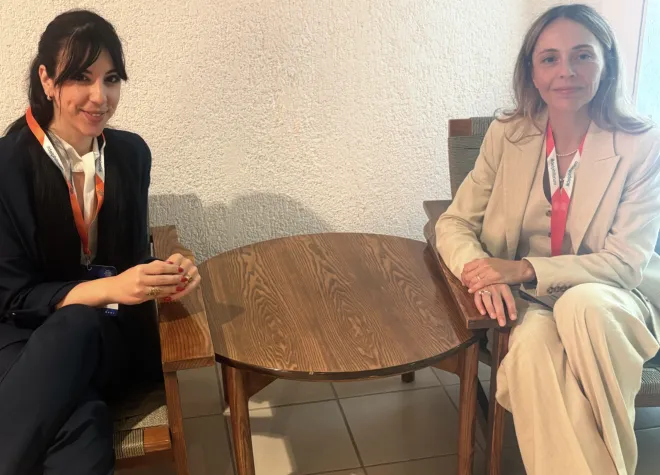
The CEO of Enaon EDA, Ms Francesca Zanninotti gave an interview to energymag.gr and the journalist Ms Margarita Asimakopoulou.
You can read the interview below:
Fr. Zanninotti: I do not see a major spike in natural gas prices – New network infrastructure in more regions of the country
Greece is not currently facing a new natural gas price crisis comparable to that of 2022, while security of supply and diversification of supply sources remain the key priorities for the energy market.
This is highlighted in her interview with Energymag by Enaon EDA CEO Francesca Zanninotti, who also presents the company’s seven-year investment plan, amounting to €1 billion, aimed at expanding the natural gas network into new regions of the country. Particular emphasis is placed on remote areas through small-scale LNG installations, as well as on network digitalisation with new “smart” meters and modern control systems. At the same time, Ms Zanninotti refers to the prospects for biomethane and hydrogen, underlining that the network is already technically ready, although financial incentives and further market maturity are still required.
To begin with, could you give us an assessment of natural gas prices as a result of the crisis in the Middle East? We see that, for now, they remain at reasonable levels. Will we see an increase in natural gas prices in Greece?
What I can say is that the natural gas price we are currently seeing in Greece is not reaching the very high levels observed during the 2022 crisis. Therefore, at present, I do not see any development that would imply such a significant impact on prices.
What is very important is security of supply, which is one of the three main pillars of the well-known energy trilemma: security of supply and sustainability (that is, decarbonisation) on the one hand, and, on the other, affordable energy prices for the consumer.
As regards security of supply, what is also very important for Greece is the diversification of supply sources. In any case, I do not see an immediate surge in natural gas prices in the country.
Let us now turn to ENAON’s investment plan. How is the natural gas network in Greece developing today?
We have presented our seven-year investment plan, which forms part of our strategic planning, and amounts to €1 billion in investments.
We are investing in expanding infrastructure to areas that have not had access to natural gas until now, beyond the more mature markets such as Athens, Thessaloniki and Larissa.
We are constructing new infrastructure in all other regions, with the exception of the Peloponnese.
At the same time, we are also investing in infrastructure for remote areas, with a new solution being implemented for the first time in Greece: LNG.
These are small LNG storage installations, which we are setting up in areas where there is no high-pressure pipeline, so that each region can be supplied.
This solution allows us to bring cleaner energy to areas that currently use more polluting forms of energy, such as Florina, Kastoria or Patras.
These are the first three cities where we have already activated this infrastructure.
Another very important part of our strategic plan is innovation and network digitalisation.
How is network digitalisation progressing in Greece, by the way?
We have already begun the large-scale replacement of traditional old meters with new smart meters.
A month ago, we started using a new smart meter developed by Italgas, which is compatible with hydrogen, up to a 23% blend.
It uses recycled materials, has a 15-year battery life, and other features that make it one of the most advanced meters on the market.
On the other hand, as far as the network is concerned, in 2025 we completed the digitalisation of the existing network.
This means we installed RTUs (Remote Terminal Units), which collect data and measurements from the field via sensors and transmit them to the central control system.
At present, we are also investing in the system’s central “brain”, called Dana, another platform developed by Italgas.
This gives us the ability to monitor the network in real time from our control room in Athens, while we are planning a similar development in Thessaloniki.
Regarding the progress of your plans for biomethane and hydrogen in Greece, what stage are we at today?
Biomethane is a solution that is already mature, and our infrastructure is fully ready and entirely compatible with it.
Last year, Greece took a very important step at the regulatory level, as all regulations concerning the production, certification and injection of biomethane into the network were approved.
What is still missing is the provision of the necessary incentives. This is essentially the final step that will unlock the ability for biogas producers, for example, to invest in upgrading and producing biomethane.
However, our network, I repeat, is already fully compatible.
As for hydrogen, we carried out an assessment across the majority of our network, covering more than 8,000 kilometres, and this study showed that 90% of the network is already compatible with a hydrogen blend of up to 5%.
At present, we are completing the replacement of the cast iron network in Athens, which is made from material that is not currently compatible with hydrogen, but this project will be completed within the year.
For the rest of the network, we are proceeding with a more specialised study, as our goal is to achieve compatibility of up to 20%, wherever technically feasible.
This study is still ongoing.
However, before hydrogen distribution or blending—and even before its production—everything will depend on economic barriers, which remain high at present.
So, it is certainly a solution for the future, but not for the immediate future.
Source: energymag.gr